It’s a common scene in a 4-room BTO showflat: a couple pacing out the 3.5 by 3 metre master bedroom, mentally placing a bed against the longest wall. They’re thinking about clearance, about fitting a wardrobe on the opposite side, about the visual balance of the space. What they aren’t thinking about is the midnight roll. For a side sleeper, that’s the critical measurement. Your bedroom floor plan tells you what can physically fit, but your sleep position dictates what you actually need.
In a 12 sqm common bedroom, a Super Single feels like a logical luxury—it’s wider than a standard Single, leaving precious floor space for a study desk. But lying on your side changes the arithmetic. You need enough surface area to shift position without your limbs dangling into the void or your shoulder pressing against the edge. That 107cm width sounds generous until you’re trying to roll from your left hip to your right without waking up. The bed might fit the room perfectly, but it won’t fit your sleep.
The real calculation isn't just about floor space; it's about your body's radius of movement. A side sleeper's shoulder needs a soft landing zone, and their knees need room to stack. In a typical HDB layout, a Queen at 152cm wide is often the smarter upgrade over a Super Single, even if it means sacrificing a bedside table or opting for a slimmer wardrobe design. The extra 45 centimetres isn't just luxury—it's functional necessity, creating a buffer zone that lets you move freely through the night. That buffer is what prevents you from subconsciously curling into a cramped ball, which only worsens shoulder and hip pressure.
There’s one genuine exception, and it’s a tight squeeze: the single-occupant room where every centimetre of floor is spoken for, maybe in a 3-room resale flat with a layout that hasn’t changed since the 90s. If the doorway clearance is truly maxed out and a Queen would block the only window or the air-con unit, then the Super Single is your compromise. Just know it’s a compromise on sleep quality, not just on aesthetics. You’ll be trading some comfort for that extra bit of walking space. For everyone else, especially couples or pregnant women advised to sleep on their side, prioritising sleeping width over walking width is a non-negotiable. The room serves the bed, not the other way around.
The tape measure tells you floor space, but it doesn't tell you how you'll sleep. You'll spend more time rotating in that bed than you will admiring its footprint against the wall. For a side sleeper, that rotation is everything—it's the difference between a shoulder that aches and one that doesn't. So stop asking if a Queen fits in the room; start asking if your sleeping body fits on the Queen.
In a typical 4-room BTO master bedroom, a 152 by 190cm Queen mattress leaves you with a decent perimeter. The real question is the space from your shoulder to your hip as you turn. If you're wedged against a wall or your partner, you'll tense up mid-sleep, and that's where the pain creeps back in by morning. You need enough clearance for your arm to extend naturally without hitting an obstacle. That's the movement space, and it's non-negotiable.
This means your bedside tables might have to shrink. A narrow ledge that holds a lamp and your phone is better than a cavernous nightstand you can't reach because the bed is shoved against it to make the room feel bigger. Accept the trade-off. The mattress width is supporting your body; the furniture is just supporting your stuff. Prioritise the first.
The only time you'd ignore this is if you sleep like a statue, never moving from the position you started in. But most of us shift, especially side sleepers seeking pressure relief. So measure the room for the body in motion, not just the bed at rest. Can you turn comfortably? If the answer's yes, the rest of the layout will follow. If not, you've bought a beautiful problem.
That initial $800 feels like a savvy spend, a Single mattress with a decent topper promising relief for your shoulder and hip. Side sleepers often think the softer comfort layer is the whole solution, focusing on foam density and contouring. The problem is, even with a perfect medium-soft feel, your body can't fully relax if it's perched right on the edge. You'll unconsciously curl inwards, fighting for space, and those pressure points you bought the topper to solve just come right back. It's a classic case of treating the symptom, not the root cause, which in many situations is pure physical constraint. That constrained space forces your spine into a slight curve, undermining the alignment the mattress is supposed to provide.
Don't just lie still in a showroom for thirty seconds; you need to simulate your actual sleep movements. Roll from your left side to your right side, stretch your arms overhead, and see how much real estate you genuinely occupy. In a cramped 91cm width, your elbows will likely knock the frame or you'll feel the imminent danger of rolling off. This test reveals the truth no static pose can: whether the size allows for the natural, unguarded shifting that happens through the night. For side sleepers, that freedom to move without restriction is what lets the pressure-relieving layers do their job properly. Skipping this is how you end up committed to a size that fails the moment you get home.
The real sting comes later, when you admit the Single isn't working and face the upgrade. Now you're looking at a Queen, maybe even a King, which in Singapore typically runs from $1,200 to $2,400 for a quality side-sleeper model. That initial $800 is sunk cost; you've effectively paid a premium to learn a lesson you could have avoided. Your total spend balloons to two grand or more, a sum that could have secured a superb, spacious mattress from the start. It's a financially painful cycle, especially when you consider that a Queen is the standard for most HDB master bedrooms anyway. The budget trap isn't just about wasting money—it's about the frustration of buying twice.
Upgrading to a Queen isn't just about the mattress price; you must consider your room's actual footprint. A 152 by 190cm frame needs clear floor space around it, especially on the exit side where you'll want at least 60cm. In a compact common bedroom, around 12 square metres, a Queen can dominate the layout, but it's usually workable with careful planning. The trap is buying a Single because the room feels small, then realising later that a Queen would have fit perfectly well—you just needed to shift the wardrobe a bit. Measure your room, tape out the dimensions on the floor, and live with that phantom bed for a few days before you decide on a smaller size out of fear.
The only time I'd consider a Single mattress a viable long-term choice for an adult side sleeper is in a truly minute space, like a study converted to a temporary sleeping area. Even then, a Super Single at 107cm provides a crucial extra 15 centimetres of width that makes a world of difference for shoulder relief. If your room can physically accommodate a larger bed, even if it feels snug, prioritising size over an initial lower price is almost always the wiser path. The correct size is a foundational need; the comfort layer is an enhancement built on top of it. Get the foundation wrong, and no amount of topping up will fix the sleep you'll get.
You lie down on a Queen-sized mattress in the showroom, sink your shoulder into the memory foam, and think you’ve found the perfect medium-firm support. But if you’re buying a Super Single for your own 4-room BTO common bedroom, that test is almost useless. The feel of a mattress changes dramatically with its dimensions—a narrower surface offers less area for your body to distribute weight, which can turn a comfortable medium-firm into a pressure-point nightmare over a full night’s sleep.
It’s a geometry problem, not just a materials one. On a wider surface, your hips and shoulders can settle more freely into the contouring layers. On a narrower one, you’re more likely to perch near the edge, where the foam is firmer and the base support less forgiving. That initial pleasant sink on a spacious showroom Queen can translate to an ache in your hip after a week on a 107 by 190cm Super Single, because your pressure points aren’t landing in the same forgiving zones.
So the rule is simple: always test on the exact size you plan to buy. If you’re a side sleeper eyeing a Super Single, don’t compromise by trying the Queen display model and hoping it feels the same. The difference in support distribution is real, and for a body that needs consistent pressure relief at the shoulders and hips, that difference matters every night. The only time this doesn’t apply is if you’re choosing between two identical mattresses where the only variable is thickness—firmness feel there is more consistent across sizes.
Settle into the showroom for a proper test on the right platform. Spend a good ten minutes on your side, letting the foam warm and contour. Notice if your spine stays in a neutral line and if your lower hip feels any pinch. That’s the only reliable way to know if a mattress labelled ‘for side sleepers’ actually works for your body on the surface you’ll sleep on. Anything else is just guessing.
That 3.5 by 3 metre master bedroom in your condo might just squeeze in a King, but the real question is what happens after you’ve shoved it against the wall. You’ll get the extra width, sure—a luxurious surface for starfishing or accommodating a restless partner. For a side sleeper, though, that extra real estate comes with a hidden trap. A larger mattress area, especially on a softer model, can tempt you towards a uniform plushness that feels cosy at first but lacks the zoned support your spine actually needs. That’s how you end up with a bed that sags in the middle after a year, leaving your hips and shoulders misaligned and your back complaining by dawn.
So the trade-off isn’t just about floor space. It’s about engineering. A Queen at 152 by 190cm gives you a more manageable canvas to build proper support layers. You can prioritise a firmer central zone to keep your spine neutral, while still allowing the shoulder and hip zones to be softer for pressure relief. With a King, the surface is so vast that achieving that precise zoning without a noticeable firmness ridge becomes a much taller order for any manufacturer. The risk is a mattress that feels like one big, slightly too-soft cloud—great for a weekend nap, terrible for chronic alignment.
My advice? Unless your bedroom is genuinely spacious—think landed property master or a generously proportioned condo layout—stick with the Queen. The support integrity you’ll gain is worth more than the extra few centimetres of width. That’s the one real exception: if your room is large enough to walk freely around a King with all your furniture in place, then you can afford to be more selective in your search for a model with advanced, zoned core construction.
Focus your hunt on the mattress’s internal layering, not just its top feel. Look for terms like “zoned support” or “targeted firmness” in the description. A good side-sleeper mattress shouldn’t be uniformly soft; it needs to be strategically soft where you need it and reliably firm where you don’t. In a compact master bedroom, that strategic engineering is far easier to find and far more effective in a Queen-sized package. The space you save is just a bonus.
Spend enough time reading mattress queries online and you’ll notice a pattern. People aren’t asking about the fluff; they’re asking about the real, everyday pain points that keep them up at night, quite literally. The questions are specific, grounded in the physical constraints of our flats and the particular aches of our bodies.
Will a standard Single mattress be enough for a side sleeper with hip pain, or is it just too narrow to let your spine relax properly?
If you’re fitting a bed into a 3-room HDB master bedroom, does the extra width of a Queen actually help a side sleeper, or does it just eat up precious floor space you need for a wardrobe?
What’s the right mattress size for a pregnant side sleeper who’s been advised to stay on her left—does she need the extra room of a Super Single or Queen to accommodate all those pillows and her changing body?
And for someone whose shoulder screams every morning, is it purely about the mattress softness, or does the width of the sleeping surface play a part in letting you sprawl out enough to relieve that pressure?
These aren’t abstract worries. They’re the direct result of trying to fit a good night’s sleep into a 152 by 190 centimetre rectangle, surrounded by built-in wardrobes and bedroom doors that barely clear the frame. The answers often hinge less on some perfect mattress model and more on recognising that your sleeping position demands space—space to sink, space to shift, and space to avoid the edge. Anything less and you’re just buying a new problem.
A King-size base covering nearly three square metres of floor space doesn't just give you more sleeping real estate—it creates a much larger surface area for our humidity to settle into. Think about it: that’s a 183 by 190cm expanse of fabric or wood pressed close to the floor, right where air circulation is weakest. In a west-facing master bedroom that bakes in the afternoon sun, you get this daily cycle of heat driving moisture out of the air at the window, only for it to condense again as the room cools overnight. Without decent cross-ventilation, that moisture gets trapped. For a landed property where some rooms might only have one window, the risk is even more pronounced. The problem isn’t the mattress itself, which you’ll rotate, but the dark, still pocket of air underneath the solid foundation.
That’s why material choice for the base becomes critical once you step up from a Queen. A solid, sealed platform base with a flat top is a recipe for trouble in our climate; it essentially creates a sealed chamber. What you want instead is something that breathes. A slatted base with gaps between the wood is the classic solution, allowing air to move. Even better are those modern ventilated bases with a mesh or fabric panel—they look solid from the side but promote airflow across the entire underside. For the mattress core itself, natural latex is famously breathable and resistant to mould, unlike some denser memory foams that can retain heat and moisture. It’s an extra layer of insurance.

The one time I’d consider a solid foundation for a King is if your bedroom’s airflow is genuinely exceptional—maybe you’ve got ceiling-to-floor windows on two walls that you keep open, or a powerful air-con and dehumidifier running nightly. Even then, I’d lift the mattress regularly to check the base and frame for any tell-tale spots. For everyone else, especially in our typical 4-room BTO layouts where the master bedroom might only have one window and an ensuite door, breathability isn’t a luxury add-on. It’s a non-negotiable for protecting your investment. You’re buying a bed for years of rest, not a science project in fungal growth.
A mattress for side sleepers must fit the room dimensions. Queen size beds, at 152x190cm, are a common fit for HDB and BTO master bedrooms. You'll want about 60cm clearance on the exit side for easy movement. This ensures the mattress complements your sleep position without dominating the space.
It’s a common misstep—you can read every spec sheet, check every density rating, and still order a mattress that leaves your shoulder aching. The gap between a product description and the actual feel under your hip is where the real decision happens, and that’s exactly why you need to get off your phone and into a showroom. For a side sleeper, the difference between a 91cm Single and a 152cm Queen isn't just about extra room to roll over; it's about how the surface area fundamentally changes the pressure relief. On a narrower bed, your shoulder can land right on the firmer edge support, defeating the purpose of a softer comfort layer. You need to feel that contouring in person.
Head down to a showroom and actually lie down in your usual sleeping position. Don’t just press the surface with your hand—your body weight and alignment are unique. Spend a good ten minutes on a Queen-sized memory foam model, like the Somnuz line, and pay attention to how it cradles your hip and shoulder. Then, for a stark comparison, try the same brand in a Single size. You’ll notice the contouring feels different, more constrained. That wider surface allows the material to properly depress and cradle your pressure points without hitting a firm perimeter too soon. It’s a tangible experience you cannot get from a website image.
This physical test is crucial before you commit to a size upgrade. A larger mattress represents a significant investment, and you want to be certain the extra width translates to genuine pain relief, not just extra unused space. In a typical 4-room BTO master bedroom, a Queen fits comfortably, but a King demands careful layout. You need to know if that jump to a 183cm width is truly necessary for your sleep posture or if the popular Queen is the sweet spot. Lying down in the showroom answers that definitively.
The only exception is if you’re absolutely space-constrained, perhaps in a smaller common bedroom. Even then, testing a Super Single versus a standard Single can reveal a meaningful gain in usable sleep surface for side sleeping. But for most, the verdict is clear after a proper test. You’ll leave knowing exactly what width your body needs—and you won’t be guessing based on a diagram.
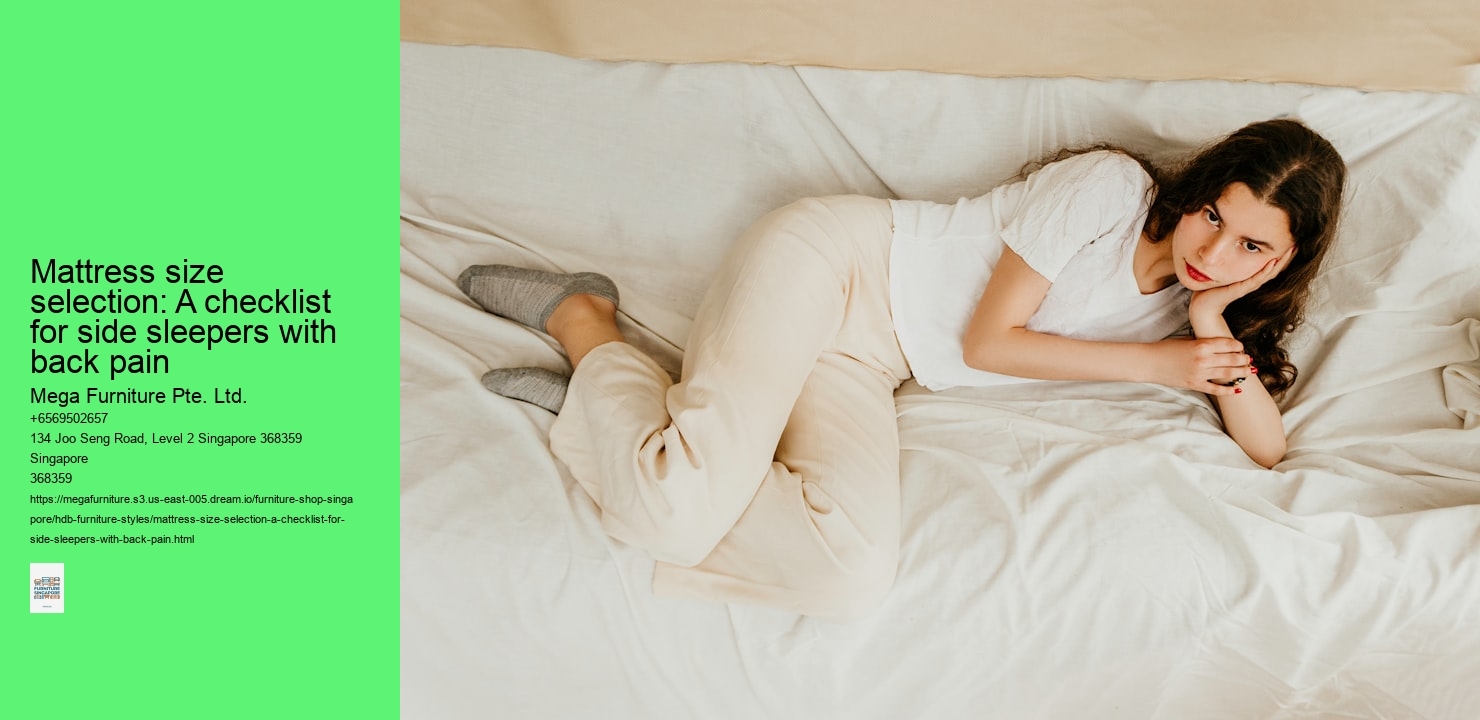
" width="100%" height="480">Mattress size selection: A checklist for side sleepers with back painYou’ve got the floor plan measured, the clearance on each side noted—good. That’s what most people bring to the showroom, and it’s not enough. For side sleepers, the critical measurement isn’t just the room; it’s the space your body needs to rotate comfortably through the night. Lie on your side on the floor, then slowly roll onto your back, paying attention to the arc your shoulders and hips travel. That’s your rotation span. If your planned mattress width leaves less than about 30cm of buffer beyond that span, you’ll be sleeping with an elbow hanging off the edge or waking up cramped.
It’s a common oversight, especially in a 3.5 by 3 metre HDB master bedroom where a Queen fits neatly with side tables. You think the layout works on paper, but the reality of a restless night with hip pain means you need that extra real estate to move without restriction. A Super Single might seem generous for one, but if your rotation span is wide, you’ll feel the constraint. Bring both numbers—the room’s dimensions and your body’s—because the showroom’s vast, perfectly made King can distort your sense of what’s necessary.
There’s one exception to this rule: if your bedroom door or the lift access is unusually tight, prioritising delivery over ideal size might be the practical choice. In many older blocks, that 90cm lift door opening is the real limiting factor, not the bedroom. A flexible mattress can bend where a rigid bed frame cannot, so sometimes the larger mattress can still make it in even when the base can’t. That’s a logistics question, not a comfort one, and it’s worth asking.
So, before you head out, take those two final measurements. It’s the difference between buying a bed that fits the room and one that genuinely fits the way you sleep.